

Among the ancient and well-established prayers are the Rosary and the litanies. To these we must add personal meditation on the lives of Jesus, Mary, and the saints, and, of course, popular religious songs, which people once sang at home, along the way, and in church.
“I hope that the Jubilee Indulgence will be for everyone a genuine experience of God’s mercy, which comes to meet all of us in the face of the Father who welcomes and forgives, completely forgetting the sin committed. To live out and obtain the indulgence, the faithful are called to make a brief pilgrimage to the Holy Door as a sign of their deep desire for true conversion.”
***
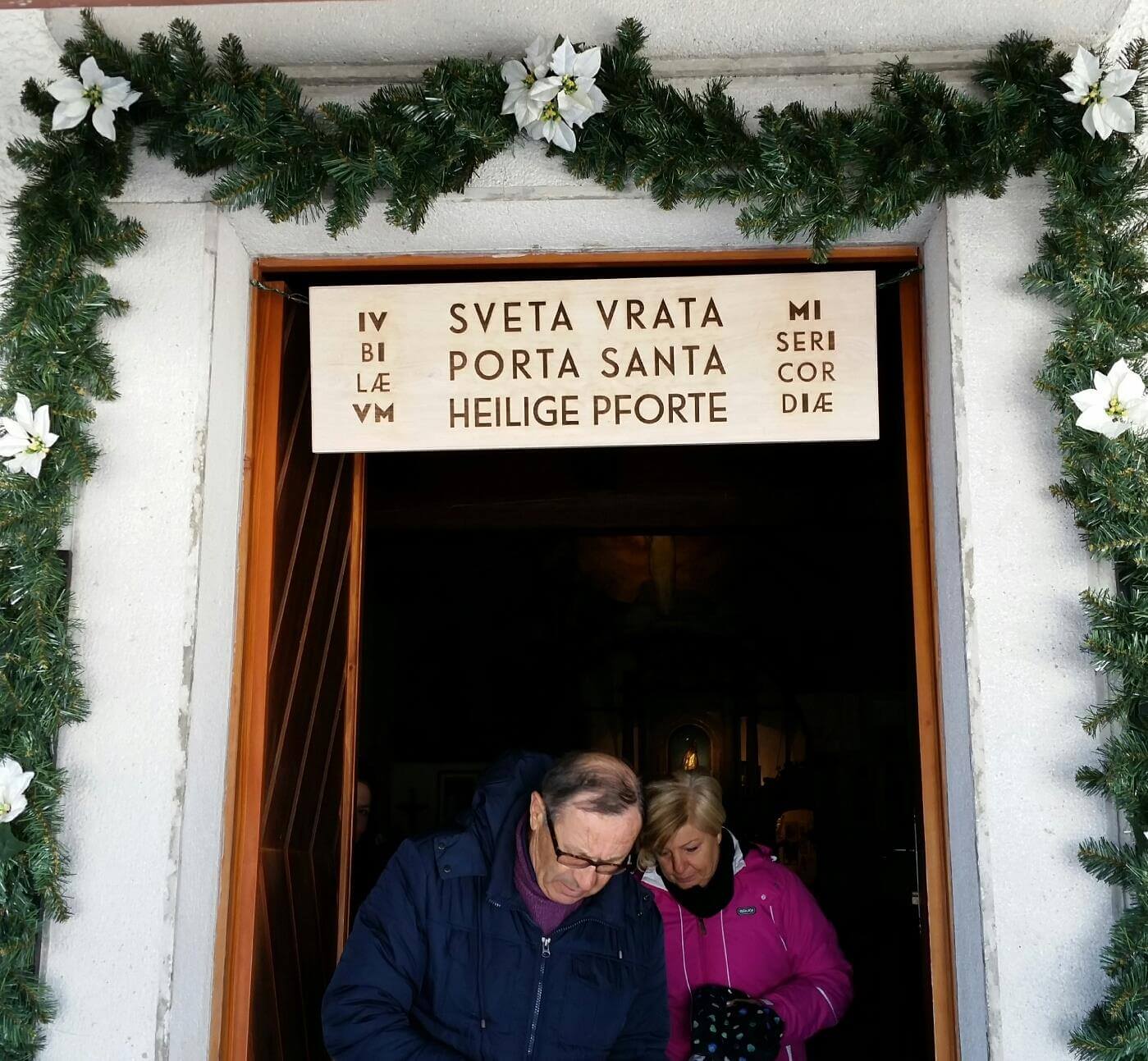
With these words, Pope Francis proclaimed the Jubilee Year of Divine Mercy, which lasted from Advent 2016 to the Feast of Christ the King of the Universe in 2017. He urged all bishops to designate at least one church within their dioceses as a Holy Year church. In accordance with the Pope’s wish, the Archbishop of Udine, Andrea Bruno Mazzocato, granted the Lussari Shrine the privilege of the Holy Year. Pilgrims who passed through the Holy Door and fulfilled other requirements received a plenary indulgence.
What is required to obtain the Jubilee Indulgence?
Pope Francis has established that it is necessary to make “a brief pilgrimage to the Holy Door, opened in every Cathedral or in churches designated by the diocesan Bishop, as well as in the four Papal Basilicas in Rome, as a sign of the deep desire for true conversion. […] It is important that this moment be linked, above all, to the Sacrament of Reconciliation and to the celebration of the Holy Eucharist, accompanied by reflection on God’s mercy. These celebrations should also include the Profession of Faith and prayers for me and for the intentions I carry in my heart, for the good of the Church and of the whole world.”
Finally, the Jubilee Indulgence may also be obtained for the faithful departed. “We remain united to them through the witness of faith and charity they have left us. Just as we remember them during the Eucharistic celebration, so too, in the great mystery of the Communion of Saints, we can pray for them, that the merciful face of the Father may free them from every remaining stain of sin and embrace them in the everlasting joy of heaven.”
From the Bull Misericordiae Vultus, by which Pope Francis proclaimed the Extraordinary Jubilee of Mercy
Jesus Christ is the face of the Father’s mercy. These words might well sum up the mystery of the Christian faith. Mercy has become living and visible in Jesus of Nazareth, reaching its culmination in him. The Father, “rich in mercy” (Eph 2:4), after having revealed his name to Moses as “a God merciful and gracious, slow to anger, and abounding in steadfast love and faithfulness” (Ex 34:6), has never ceased to show, in various ways throughout history, his divine nature. In the “fullness of time” (Gal 4:4), when everything had been arranged according to his plan of salvation, he sent his only Son, born of the Virgin Mary, to reveal his love for us in a definitive way. Whoever sees him sees the Father (cf. Jn 14:9). By his words, his actions, and his entire person, Jesus of Nazareth reveals the mercy of God.
In the parables devoted to mercy, Jesus reveals God’s nature as that of a Father who never gives up until he has overcome sin and rejection with compassion and mercy. We know these parables well, especially three of them: the lost sheep, the lost coin, and the father with his two sons (cf. Lk 15:1–32). In these parables, God is always presented as overflowing with joy, especially when he forgives. In them we find the very heart of the Gospel and of our faith, for mercy is revealed as a force that conquers all, filling the heart with love and bringing consolation through forgiveness.
Another parable also offers us an important lesson for our Christian way of life. When Peter asked how many times he should forgive, Jesus answered, “I do not say to you seven times, but seventy-seven times” (Mt 18:22), and told the parable of the “merciless servant.” Summoned by his master to repay a great debt, the servant fell to his knees and begged for mercy, and the master forgave the debt. But immediately afterward, he encountered a fellow servant who owed him only a small amount. Although the man pleaded on his knees for mercy, he refused and had him thrown into prison. When the master learned what had happened, he became angry and said to him: “Should you not have had mercy on your fellow servant, as I had mercy on you?” (Mt 18:33). Jesus concluded: “So my heavenly Father will do to every one of you, if you do not forgive your brother or sister from your heart” (Mt 18:35).
The parable of the merciless servant contains a profound lesson for each of us. Jesus teaches that mercy is not only the way the Father acts; it also becomes the criterion for recognizing who his true children are. We are called to show mercy because mercy has first been shown to us. Forgiving offences is the clearest expression of merciful love, and for Christians it is an imperative from which we cannot escape. How difficult it often seems to forgive! Yet forgiveness is the instrument placed into our fragile hands to bring peace to our hearts. Letting go of resentment, anger, violence, and revenge is necessary if we are to live happily. Let us therefore heed the Apostle’s exhortation: “Do not let the sun go down on your anger” (Eph 4:26). Above all, let us listen to Jesus, who made mercy an ideal of life and the criterion for the credibility of our faith: “Blessed are the merciful, for they shall obtain mercy” (Mt 5:7). This is the Beatitude that should inspire us with particular commitment during this Holy Year.
As Sacred Scripture clearly shows, mercy is the key word that describes God’s action toward us. He does not simply declare his love; he makes it visible and tangible. Love can never be merely an abstract word. By its very nature, it is concrete: intentions, attitudes, and actions expressed in everyday life. God’s mercy is his loving responsibility for us. He feels responsible for us; he desires our good and wants to see us happy, filled with joy and peace. Christian love must follow this same path. As the Father loves, so his children must love. As he is merciful, so we too are called to be merciful to one another.
The very foundation that supports the life of the Church is mercy. Everything in her pastoral activity should be marked by the tenderness with which she reaches out to believers. Nothing in her proclamation or witness to the world can lack mercy. The Church’s credibility is seen in how she shows merciful and compassionate love. The Church “has an endless desire to show mercy.” Perhaps for too long we have forgotten how to point out and live the way of mercy. On the one hand, the temptation to insist only on justice has made us forget that justice is only the first, though necessary, step. The Church must go beyond it in order to reach a higher and more meaningful goal. On the other hand, it is sad to see how the experience of forgiveness is becoming increasingly rare in our culture. Even the very word “forgiveness” seems at times to disappear. Yet without the witness of forgiveness, life becomes barren and sterile, as though we were living in a desolate desert. The time has come once more for the Church to take up the joyful proclamation of forgiveness. It is time to return to what is essential, bearing the weaknesses and struggles of our brothers and sisters. Forgiveness is a power that raises us to new life and gives us the courage to look to the future with hope.
The Church is called to proclaim the mercy of God, the beating heart of the Gospel, which through her must reach the heart and mind of every person. The Bride of Christ adopts the attitude of the Son of God, who goes out to everyone without excluding anyone. In our own time, when the Church is engaged in the new evangelization, the theme of mercy needs to be proclaimed anew with fresh enthusiasm and renewed pastoral commitment. It is essential for the Church and for the credibility of her message that she herself live and bear witness to mercy. Her language and her actions must communicate mercy, so as to touch people’s hearts and inspire them to find their way back to the Father.
The first truth of the Church is the love of Christ. The Church makes herself the servant and mediator of this love, which reaches even to forgiveness and the gift of self. Therefore, wherever the Church is present, the mercy of the Father must be evident. In our parishes, communities, associations, and movements—in short, wherever Christians are found—everyone should be able to find an oasis of mercy.
Pope Francis’ Prayer for the Jubilee
Lord Jesus Christ,
You have taught us to be merciful like the heavenly Father, and You have told us that whoever sees You sees Him. Show us Your face, and we shall be saved.
Your loving gaze freed Zacchaeus and Matthew from the slavery of money; the adulterous woman and Mary Magdalene from seeking happiness only in created things; it brought Peter to tears after his betrayal, and assured Paradise to the repentant thief.
Grant that each of us may hear, as spoken personally to us, the words You addressed to the Samaritan woman: “If you knew the gift of God!”
You are the visible face of the invisible Father, of the God who reveals His omnipotence above all through forgiveness and mercy. Grant that the Church may be, in the world, the visible face of You, her Lord, risen and glorified.
You willed that Your ministers should also be clothed in weakness, so that they might feel true compassion for those who are in ignorance and error. Grant that everyone who approaches them may experience being welcomed, loved, and forgiven by God.
Send forth Your Spirit and consecrate us all with His anointing, so that the Jubilee of Mercy may be a year of the Lord’s grace, and that Your Church, with renewed enthusiasm, may bring the Good News to the poor, proclaim liberty to captives and the oppressed, and restore sight to the blind.
We ask this through the intercession of Mary, Mother of Mercy, to You who live and reign with the Father and the Holy Spirit, for ever and ever.
Amen.