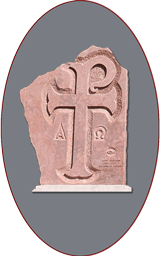
Marian Shrine

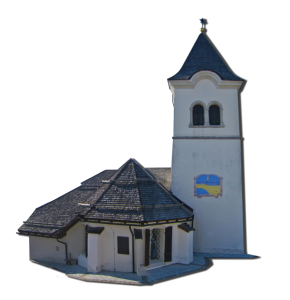
A small chapel and later a church were built on the site where the statue of the Mother of God was found. Despite political and linguistic divisions, Our Lady of Mount Lussari remains the Mother of all nations and the Queen of Europe.

When we enter the Shrine of Mount Lussari, we are embraced by a peaceful, softly lit interior, with solid stone walls and a roof resembling the hull of a ship. From the wall separating the sanctuary from the nave, Mary—Mother of Jesus and our Mother—greets us with outstretched arms.
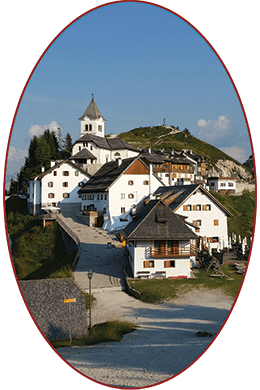
She opens her mantle like a sail, filled with the warm rays of the sun—of God Himself. With this mantle, a symbol of God’s love for humanity, she embraces the pilgrims who come to the place where, more than 650 years ago, a young shepherd found her little statue.

There is room beneath her mantle for you, for me, and for the thousands of pilgrims who come here every year.

Creation

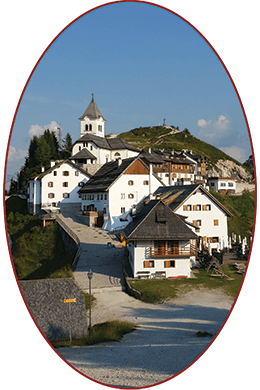
At Mount Lussari, the Julian Alps, the Carnic Alps, and the Karawanks meet. Its waters flow toward both the Adriatic and the Black Sea. The valleys of the Drava, Sava, Soča, and Fella all lead to this mountain.

From a geographical perspective, Mount Lussari is truly unique. It is like an island from which four important river systems originate or are nourished. Part of its waters flow north into the nearby Drava River, while those on its southern slopes feed the Fella River, which eventually reaches the Adriatic Sea.

To the east, two low mountain passes separate the Canal Valley from the headwaters of the Sava and the Soča (through the Koritnica stream), whose waters flow into two different seas. The Canal Valley—and especially Mount Lussari—is therefore the meeting point of four important Alpine valleys.

Reflecting on this mountain, Dr Lambert Ehrlich, a native of the Canal Valley, wrote that the border on Mount Lussari does not divide but unites three great cultural traditions: the Slavic, the Germanic, and the Romance.

History

The Canal Valley links the Po Plain and the Italian Peninsula with Central and Northern Europe. Throughout history, Celts, Romans, Slavs, Germans, and Italians have all left their mark on this region.

Thanks to its strategic location, the Canal Valley has long served as an important route between Northern Europe and Italy. Around 1000 BC, the local tribes came under the authority of the Illyrians and the Paleo-Veneti, who arrived from the east.

Around 400 BC, Celtic peoples settled in the region, belonging to three tribes: the Norici, the Taurisci, and the Carni. Roman rule did not significantly alter the ethnic composition of the population.

Nor did the later settlement of the Slavs, who arrived from the northeast, fundamentally change the Celtic cultures that had already taken root in this part of the Alps.