
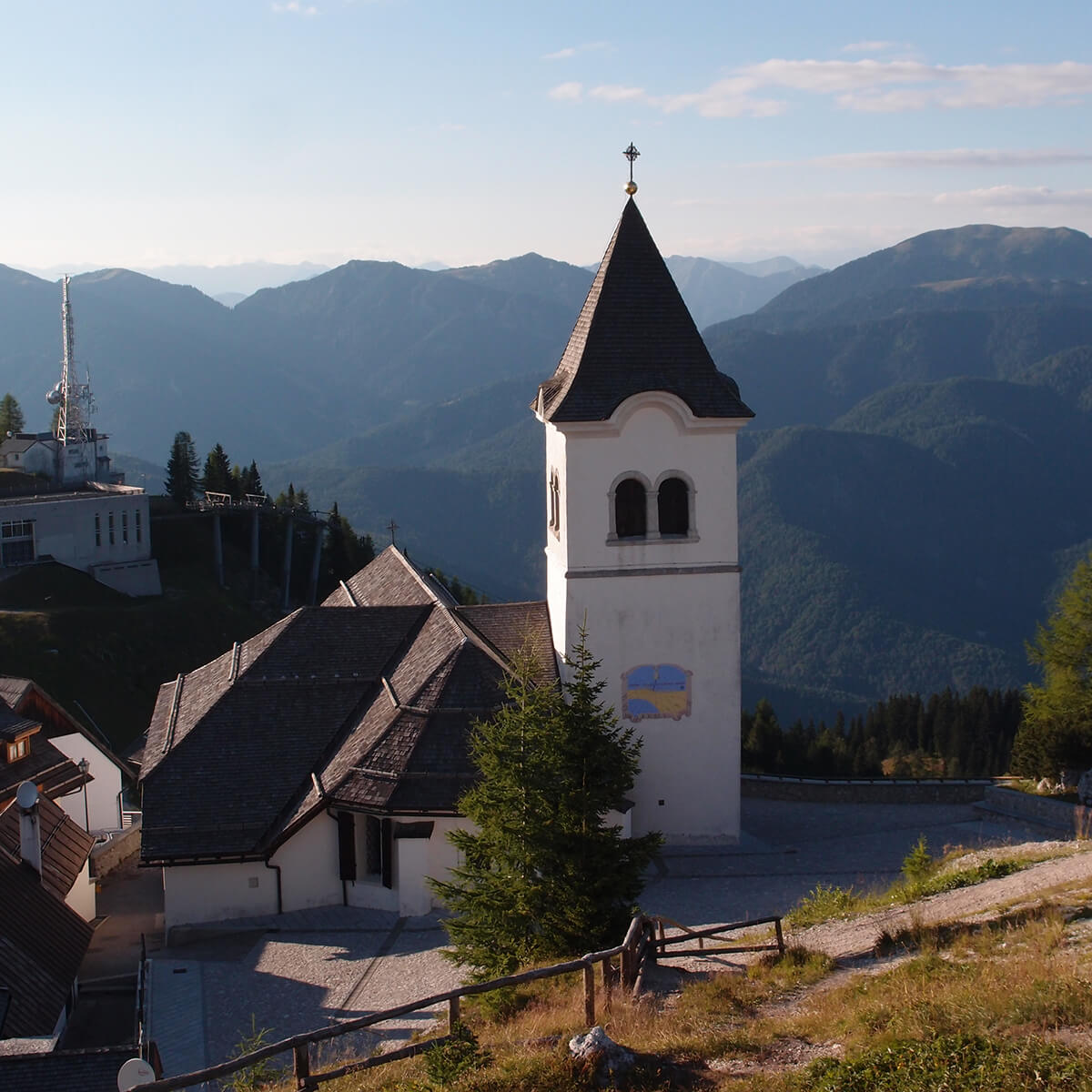
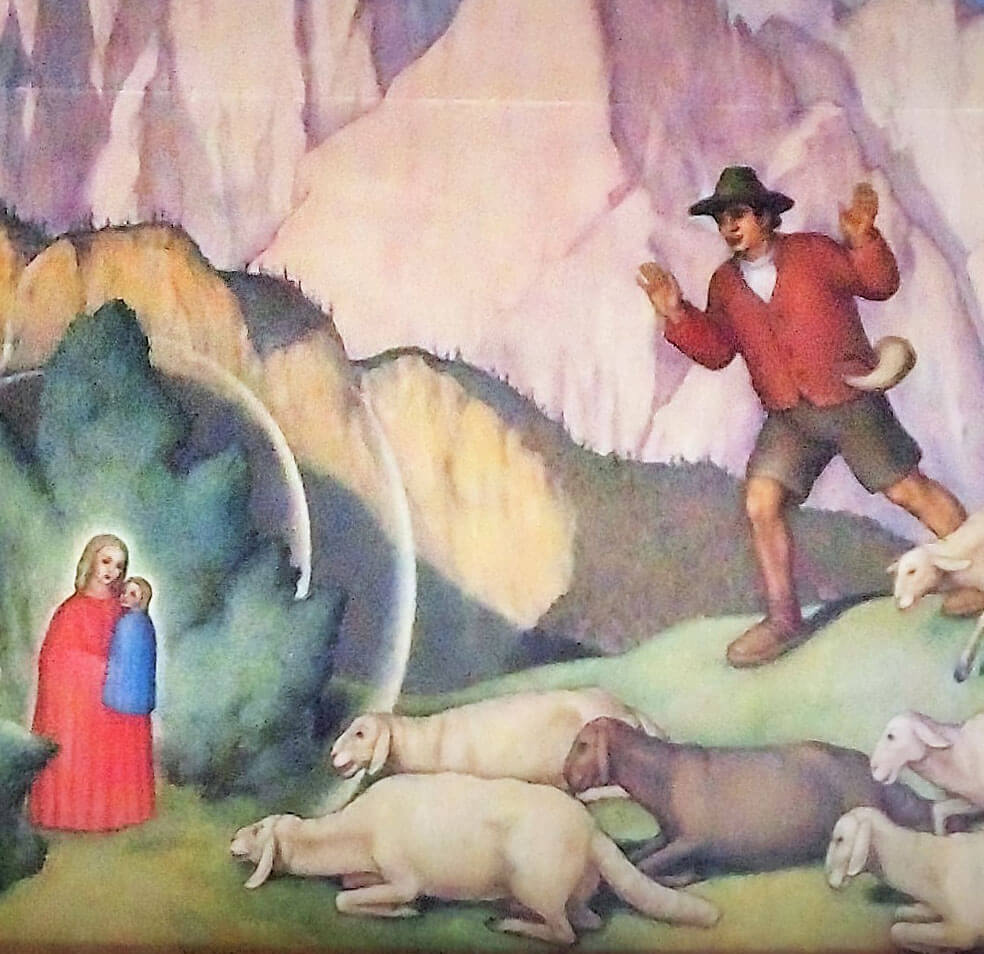
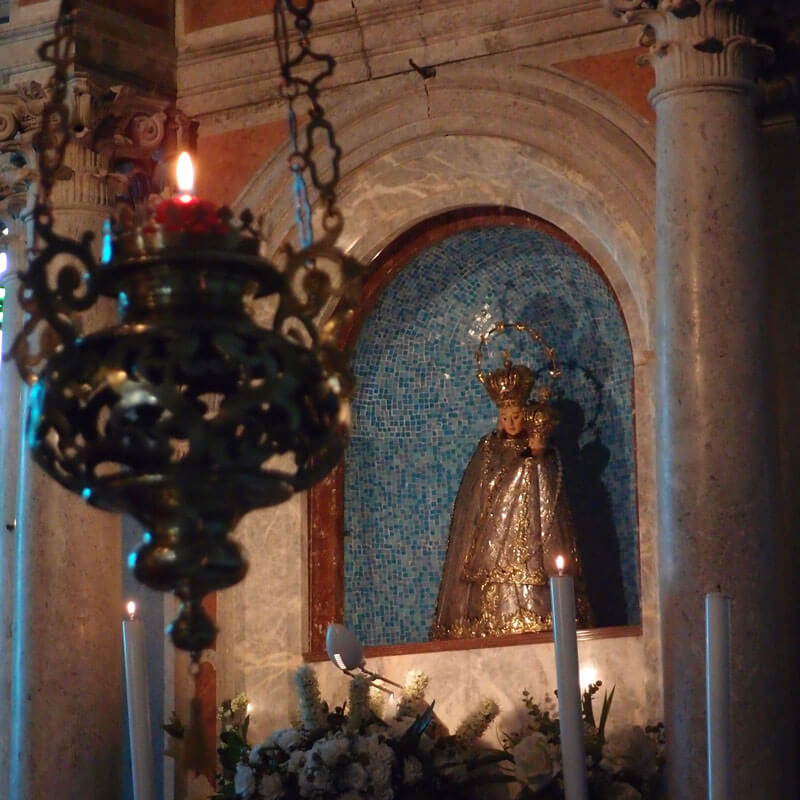
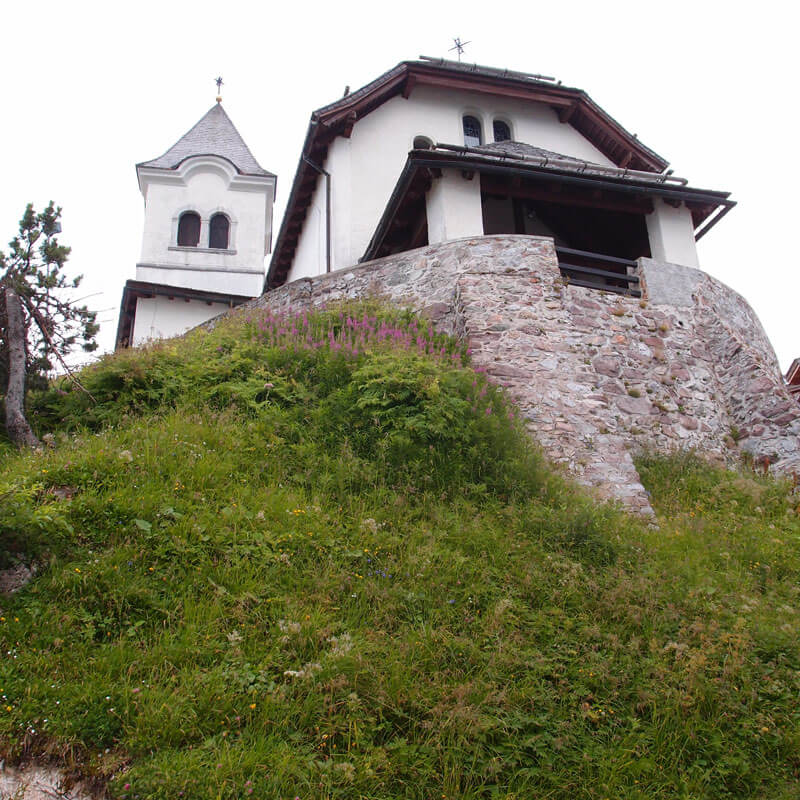
On the spot where the little statue of the Mother of God was found, a small chapel arose, and later a church. Despite political and linguistic divisions, Mary of Lussari remains the mother of all nations, queen of Europe.
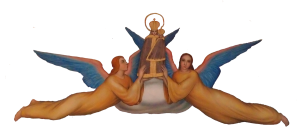
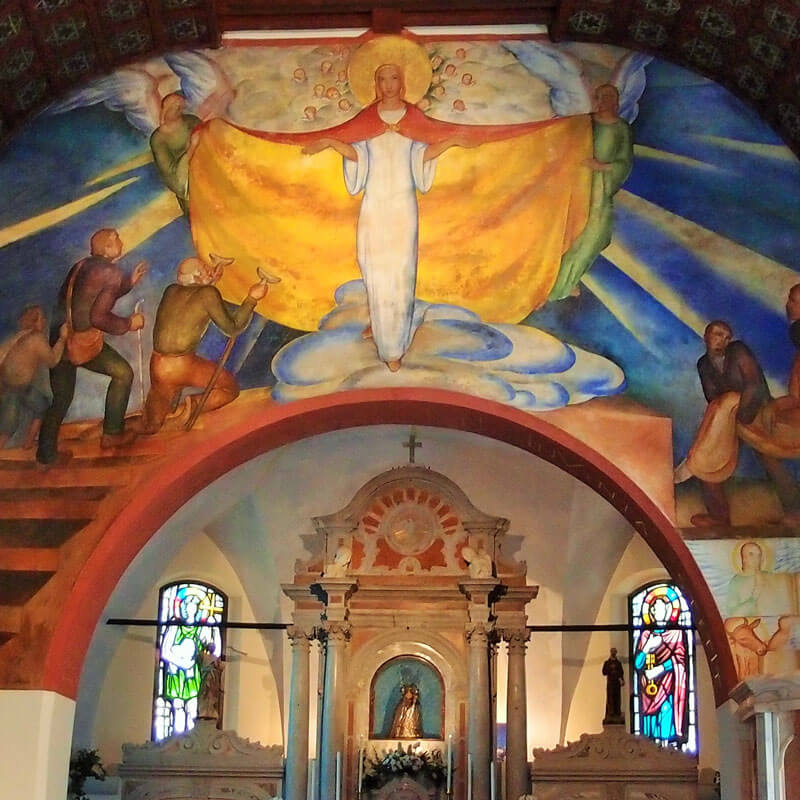
When we enter the sanctuary of Lussari, we are embraced by a pleasantly dim setting, with thick, sturdy walls and a roof reminiscent of a ship. From the wall dividing the presbytery and the nave, Mary, mother of Jesus and of us all, greets us with open arms. She opens her mantle like a sail, in which warm rays of sunlight – of God – have been caught. With this mantle, a symbol of divine love for mankind, she embraces the pilgrims who arrive at the place where a young shepherd, 650 years ago, found her graceful little statue. Under this mantle there is room for me, for you, and for all the thousands who set out on pilgrimage every year.
***
According to tradition, a small chapel was soon built on the spot where the statue was found, and over time it developed into a church. A rectory and structures to welcome pilgrims were added to it. The church survived every calamity, whether natural or man-made. In the zeal of the Enlightenment it was destroyed by Emperor Joseph II, who wished to root out “backward” popular devotions. In the First World War it burned under artillery fire together with the hamlet. Except for the walls, today only the little statue of Mary and a burnt relief embedded in the eastern wall of the nave recall the old church. But after every catastrophe, whether natural or man-made, the sanctuary has always risen again.
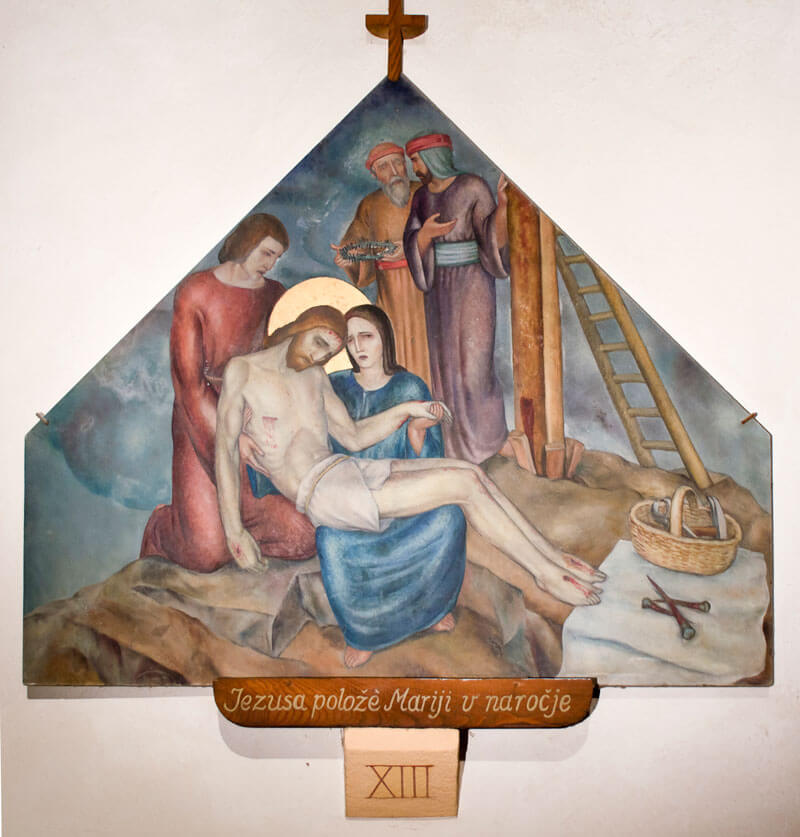
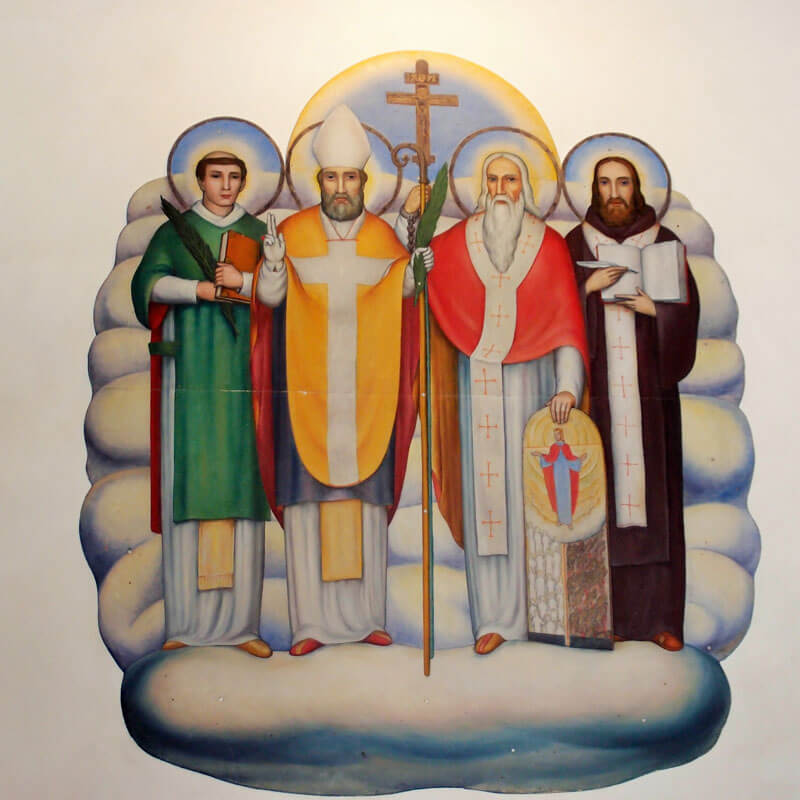
The strongest mark on the rebuilt church was left by the painter Tone Kralj, who in the 1930s frescoed the presbytery. He finished the work after the Second World War, in 1960. In the presbytery are depicted scenes from the life of Mary: the Annunciation, the flight into Egypt, the finding of Jesus in the Temple, the crucifixion, and the coronation of Mary. On the separating arch he depicted Mary with the mantle, to whom the pilgrims turn. In the side chapel to the north we see the altarpiece with Anna, Joachim, and the young Mary; on the side walls of the nave, instead, two historical depictions: the finding of the little statue and the devastation of the First World War. Also by Kralj is the painting of the Slavic apostles St. Cyril and St. Methodius, in the company of the patrons of the Patriarchate of Aquileia, Saints Hermagoras and Fortunatus.
After 1960, Kralj’s Way of the Cross also found a home in the church, having been created to be placed along the ancient pilgrim’s path. The local inhabitants never finished the work begun in the 1930s. In recent years, together with them, pilgrims have taken up the original idea again and begun building the last structures, in which copies of Kralj’s Way of the Cross will be displayed.
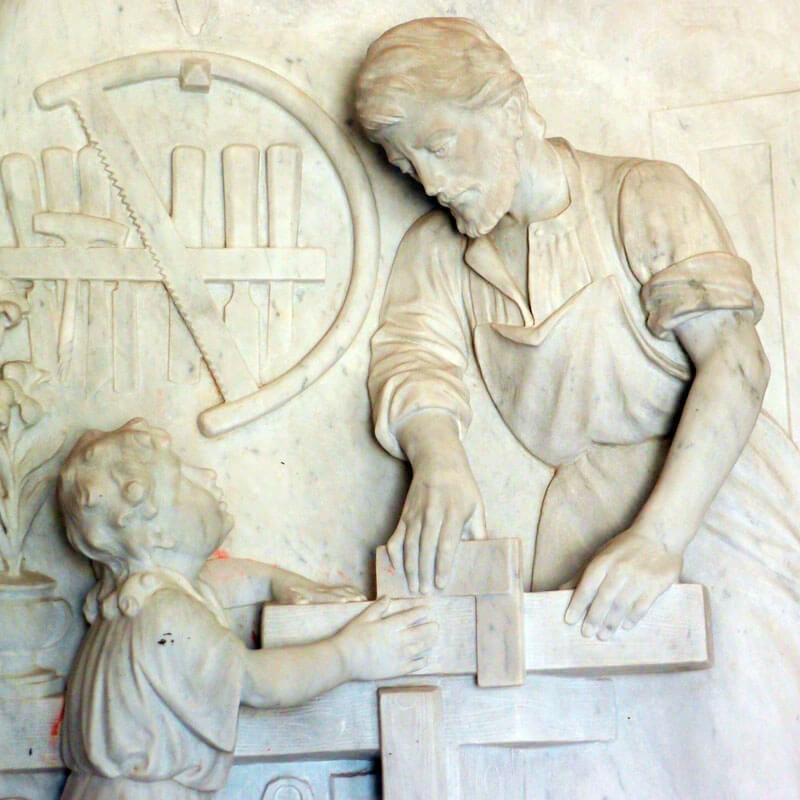
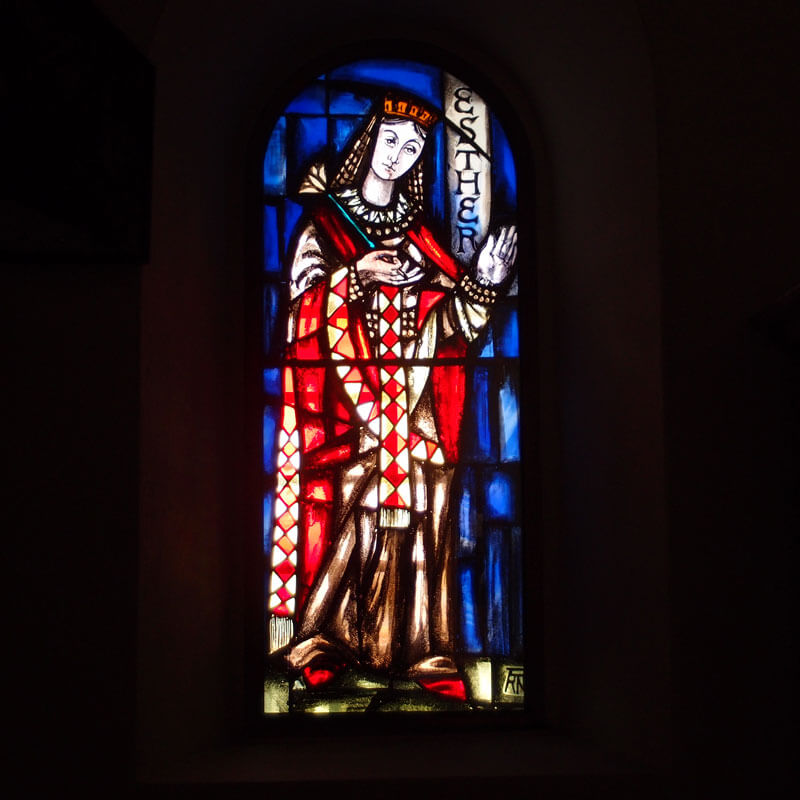
While Kralj’s works are mainly dedicated to Mary, to the church of Lussari, and to the suffering of Jesus, the stained-glass windows instead tell us of the continuation of Jesus’ work in the world, which is the Church. From the windows of the presbytery, Jesus’ predecessor, St. John the Baptist (on whose feast day the pilgrimage season usually began), and his successor St. Peter, the first Pope, greet us. Facing them, in the portal above the main door, are represented two pairs of saints who have marked our history. On the sides are St. Paulinus, an important patriarch of Aquileia, and St. Benedict, patron and teacher of Europe. In the centre are two contemporaries from the 19th century, St. Luigi Scrosoppi of Udine and Blessed Anton Martin Slomšek of Maribor. The side chapel, dedicated to Saints Joachim and Anna, connects us, through the young Mary, to human history, which begins with the exile of our first parents Adam and Eve from earthly paradise. Two biblical women, Judith and Esther, prepare the way for Mary, the woman who bore the Son of God, who redeemed us from the sin of our first parents. In the chapel of St. Joseph, instead, are depicted the patron of the parish of Camporosso, St. Giles, and the patron of woodcutters and foresters, St. John Gualbert.
The sacred place
The church building is a consecrated space. The church is set apart from everyday use because extraordinary things happen within it: it is not merely a physical space, but a particular existential dimension, in which all places and all times are simultaneously present. Here we Christians gather for Mass, that moment in which the Last Supper of Jesus, his suffering, and his crucifixion become present. In church we normally baptise new members of the community and confirm them with the sacrament of confirmation. Here Christians marry and are ordained deacons, priests, and bishops. In church we often gather for prayer, we reconcile with God and with our neighbour; it is the place where we pronounce our vows to God.
The church building and its art seek to bring us into a reality that connects us beyond the boundaries of time and space, in which even death does not mean final separation. In the sacraments, above all the Mass, we enter into the transcendent event of Christ’s work and presence, which began during the years of his life in Palestine, and which, by the power of His death and resurrection, continues until the end of days. The Christian’s life is not limited to the space and time that he directly experiences. When the Christian is connected to God, he enters a reality that transcends space and time. For the Christian, life does not end with death; for this reason he remains in relationship with the deceased, since they live in the same way that Christ lives. This faith and this bond with them are expressed through prayer, especially when we remember them at Holy Mass.
The church building helps us gain access to this reality, greater than our experience of time and space. This is why the church windows are not transparent. They are not meant for looking through at the surrounding space. It is true that they let light into the sacred place, yet their purpose is something else: through the coloured windows God “looks” into our world, into our life. In church our life is literally presented to us in another light: through the windows God looks upon us and upon the community in which we live, and he invites us too to look at ourselves and at the world through his eyes. That this is possible is reminded to us by the saints depicted on the windows. The saints are our brothers and sisters, who knew how to look at the world and at people with the eyes of God.
All the art of the church serves this purpose. The paintings and statues bring us to that dimension of life which escapes our direct experience, both because of its distance in time and because of its transcendent nature. The figures of the saints are not there to awaken the memory of something that was and has passed, but to assure us that they are still with us. Not only through the effects of their own works, but above all because they live in God. The angels and the other symbols of God point to that transcendent reality which we can neither fully understand nor fully experience, but which is, at the same time, part of our life. So, when we cross the threshold of the sanctuary, we enter another world. Or rather: we enter a world that encompasses everything we have brought with us and everything that awaits us outside the sanctuary, but which at the same time transcends all of this, and which therefore allows us to see ourselves and the world with the eyes of God. The church building places us within a greater reality.
When we enter the sanctuary of Lussari, we are embraced by a pleasantly dim setting, with sturdy, thick walls and a roof reminiscent of a ship. From the wall that divides the presbytery and the nave, Mary, mother of Jesus and of us all, greets us with open arms. She opens her mantle like a sail, in which warm rays of sunlight have been caught. The sun is an ancient symbol of God. With this mantle, a symbol of God’s love for mankind, Mary embraces the pilgrims who arrive at the place where a young shepherd, 650 years ago, found her graceful little statue. Under the mantle there is room for me, for you, and for all the thousands who set out on pilgrimage every year.
The church of Lussari speaks of two families. First it presents to us Mary’s family: the lineage from which she was born and the closer family circle in which Jesus Christ was born and raised. At the same time, it surrounds us with the family founded by Jesus through his own suffering, death, and resurrection. This is the community of the faithful, which includes Mary, the apostles, and all Christians – or rather, all people of good will and indeed all of creation. Some of them are depicted on the walls and windows; for others we pray or to them we entrust ourselves.
The side chapels tell us of Mary’s birth and family. The chapel on the left is dedicated to her parents Joachim and Anna. In it are also depicted Adam and Eve, our first parents, who represent the fall of mankind and the estrangement from God and from paradise. Esther and Judith, two important women from the history of the people of Israel, link the first parents to Mary’s family. The chapel on the right is dedicated to St. Joseph. The presbytery, with scenes from their lives, speaks of Mary, Joseph, and Jesus. In the presbytery stand the altar, a symbol of God’s offering for us, and the tabernacle, in which the eucharistic bread is kept, the sacrament of Jesus’ continual presence among us.
Key figures from our history present to us renewed humanity: the Christian community, founded by Jesus Christ. Behind, near the entrance of the church, our “patriarchs” greet us – men who proclaimed and communicated the faith in Christ to us. On the left is Patriarch Paulinus, who worked on the proclamation of Christianity in the lands south of the Drava; on the right, Abbot Benedict, founder of monasteries, which were centres radiating Christianity and classical culture in those parts of Europe that gave way to the wave of tribes from the east and north – the wave of our pagan ancestors. In the centre are Luigi Scrosoppi and Anton Martin Slomšek, two contemporaries from the 19th century, who, each in his own place, educated and instructed people, also helping them concretely, according to Jesus’ commandment of love for one’s neighbour. Joining them are the founders of the Christian community in our area: the patrons of Aquileia, Hermagoras and Fortunatus, who marked the area between the Adriatic Sea and the Drava; Cyril and Methodius, instead, transmitted the faith to the Slavs.
The space of the church seeks to help us gain conscious access to that history which the aforementioned people significantly shaped. Our spiritual ancestors are here; we carry their “spiritual DNA” within us. They laid the foundations of our culture; it is because of them that we are what we are. Their choices and their work have consequences for us, today. It is up to us, however, to immerse ourselves in this dimension of our reality and accept it, so as to add our own brick and place our own little stone in the mosaic – or to pass by superficially like a light breeze, which for a moment stirred up a little dust, then vanished and was forgotten.
The church is a construction of a particular kind, and it is good that we realise this. Like any other construction, it must meet the criteria of civil engineering and art. It is made of quality materials and decorated with high-level works of art. Yet science and art are not ends in themselves; they serve so that God and his family may more easily meet in a concrete time and space. Sacred places help us better understand who we are and what we are called to.