
The Val Canale connects the Po Plain and the Italian peninsula with central and northern Europe. In it, the Celts, the Romans, the Slavs, the Germans, and the Italians have left more or less lasting traces.
Because of its favourable geographical position, the Val Canale is an important communication route between northern Europe and Italy. Around the year 1000 BC the tribes living there had to recognise the authority of the Illyrians and the Paleo-Venetians, who arrived from the east. Around 400 BC the Celts settled in the area, divided into three tribes: the Norici, the Taurisci, and the Carni. Roman authority did not bring about major changes in the composition of the population. Nor did the later settlement of the Slavs, coming from the northeast, essentially change the existing Celtic cultures in this part of the Alps.
***
Evidence of the Roman presence is provided by the discovery of a mithraeum and other finds at Camporosso. In 1007 the Val Canale came under the authority of Bamberg, though it remained subject to the Patriarchate of Aquileia in ecclesiastical matters. Both geographically and administratively, the Val Canale was part of Carinthia until the end of the First World War. In the 18th century it became part of Austria, with the border at the locality of Pontebba. The Napoleonic wars did not leave as deep a mark in these areas. The 1910 census gave the following picture: Germans 77%, Slovenes 20%, others 3%. Ten years later, after the Italian occupation, 50% were recorded as Germans, 13% as Slovenes, and 14% as Italians, while the remaining 20% declared themselves otherwise. Shortly before the Second World War, as part of an agreement between Hitler and Mussolini, the inhabitants of the Val Canale could opt for the Reich or for Italy. German and Slovene speakers (together 80% of the population) opted for the Reich. The majority, that is, nearly 60% of the population, accepted Germany’s offer and moved there. With this, the valley permanently lost its Austrian (Slovene and German) character.
The years of Fascism and the Second World War were marked by a determined Italianisation and by the emigration of the German- and Slovene-speaking population. The war and the communist revolution, which posed a threat from neighbouring Yugoslavia, made relations between the ethnic groups even more tense, as had already happened from time to time before.
After the Second World War, and especially after the collapse of the Soviet communist empire, political borders opened up and connections and exchanges relaxed; linguistic and cultural differences, on the contrary, grew stronger. While more than a hundred years ago the inhabitants of the Val Canale generally understood and spoke all three languages, today only a handful of people are able to do so.
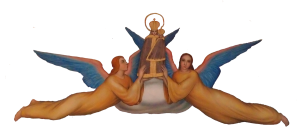
The discovery of the little statue of the Mother of God undoubtedly represents a turning point in the history not only of Lussari, but also of Camporosso, of Tarvisio, and of the whole Val Canale. Tradition tells us of a young shepherd led by his sheep to the place where, under a bush, he found the statue of Mary with the Child, which he brought down to the valley to the parish priest. The priest kept it in the rectory, but the statue kept finding its way back up the mountain. After consulting with the Patriarch of Aquileia, a small chapel was built on the site where it was found, and later a church, which became a destination for pilgrims from a wide surrounding area.
Because of its mountain location, the church was open only in the summer months, from the feast of St. John the Baptist (24 June) to the first Sunday of October. During that time, priests were present at Lussari for confession and the celebration of Mass. Next to the rectory a refreshment point also arose, where pilgrims could spend the night and get something to eat. Chronicles report that in the short summer months as many as ten thousand pilgrims reached Lussari, and this at a time when there were no modern means of transport and no cable car. Naturally there were also “lean” periods, among which we recall that of Joseph II’s reforms at the end of the 18th century and that between the two World Wars of the 20th century. At those times pilgrimages ceased completely, and the statue of Mary was instead moved down to the valley. During Joseph II’s reforms and during the First World War the church was deliberately destroyed; but natural disasters and fires were not lacking either, which at times damaged the church, itself exposed, and the remaining buildings.
A great trial was represented by the First World War and by the decades that followed it – not only because the entire hamlet was burned, including the church. The war ended with the dissolution of the Austro-Hungarian monarchy. The Paris Peace Conference divided the area of origin of the majority of the pilgrims among three states: Austria, Yugoslavia, and Italy. The consequence of the new borders was that the flow of pilgrims to Lussari contracted sharply. The changed administrative circumstances made it more difficult to rebuild the church and the settlement, and it also played a part that control of the mountain passed into civil hands, which did not always have an ear for the religious character of Lussari. It did not take long before the small stalls selling candles and religious souvenirs grew into shops and restaurants.
In the second half of the 20th century and at the beginning of the 21st, Lussari experienced a new flourishing, with the cable car and the celebration of jubilees. 1960 passed under the sign of the 600th anniversary of the finding of the little statue; in 2010 the 650th was celebrated, and in the meantime the great jubilee of 2000 had also been celebrated. Even earlier there had been the earthquake, which required restoration work. In 1960 Tone Kralj completed the preparation of the church’s frescoes, which he had begun in the 1930s. For the jubilee of 2000 the area around the church was rearranged, and its walls were reinforced. The rectory and the remaining buildings, which belong to the sanctuary and serve primarily to host pilgrims, were also renovated.
The second half of the 20th century also brought growth in tourist activity in the Val Canale and at Lussari. With the construction of the ski slopes, the cable car, and the ski lifts, pilgrimages and visits are no longer limited to the summer months; the church is always open when the cable car is running. Commercial activity has grown especially in the winter months, when Lussari is mostly visited by tourists, while in summer it is visited mainly by pilgrims.
KANALTAL / VALCANALE – Deutschsprachige Gemeinschaft in der Provinz Udine